âFirst Red Clausewitzâ: Friedrich Engels And Early Socialist Military Theory by Michael A. Boden
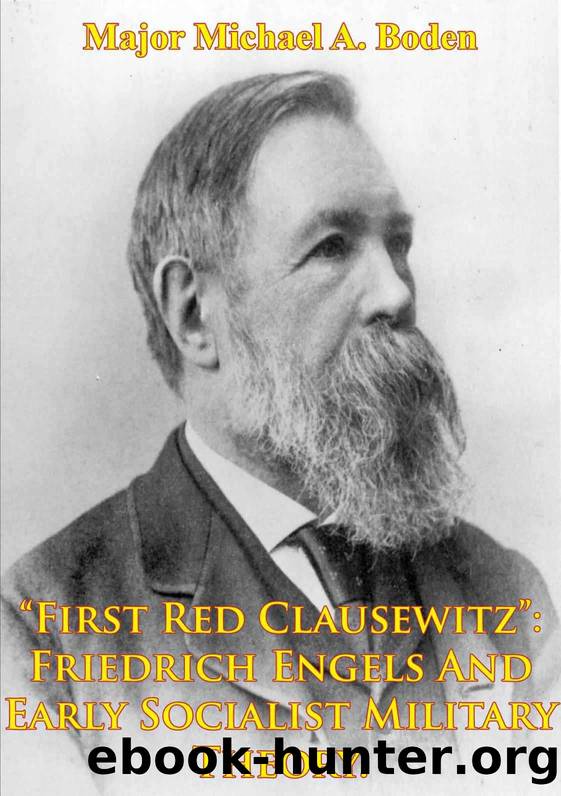
Author:Michael A. Boden [Boden, Michael A.]
Language: eng
Format: epub
Publisher: Pickle Partners Publishing
Published: 2014-08-15T00:00:00+00:00
CHAPTER 5 â PROBLEMS BETWEEN WAR AND REVOLUTION
Economics
It is somewhat surprising that for all of the importance of economics in the theoretical observations and logic of Karl Marxâs thought, and of communism in general, that subject figured so little in Engelsâ reflections concerning war and fighting. Surprisingly, when Engels first read one of the most well-known military missives of the nineteenth century, Prussian General Carl von Clausewitzâs On War, the first thing that caught his attention was the way in which Clausewitz incorporated commerce into war. Engels specifically drew Marx to this correlation.{286} Certainly, there were frequent examples of how economics functioned in conflict, but for the most part, these observations occurred primarily in the early years of his writing, and seldom concerned any innovations at the tactical levels of warfare. Distinct themes surface throughout these writings, however, particularly the role of conflict in resolving the struggle between rich and poor, and the importance of financial viability in the execution of warfare as an increasingly expensive field. In this last regard, Engels made several very insightful observations, and almost foreshadows later writers, such as Jean de Bloch, who, at the turn of the twentieth century, pointed to the difficulty of waging and financing war on a mass scale.
In all of Engelsâ writings concerning war and the nature of conflict, the position of economics was one of the first that he discussed to a great extent. Early in the 1840s, when he first struggled with the questions of inequality between classes Engels commonly wrote about the struggle between those with wealth and those without. Most of these observations, however, were simplistic revelations of comparison, equating bigger with better, larger with stronger, and weaker with smaller. While not completely misguided, such comparisons led Engels to adjudicate the potential results of such struggles on a very singular formulaâthe side with the most numbers and resources will always win.{287}
He would, however, expand this view by the middle of the decade, when he wrote his famous Condition of the Working Class in England. While maintaining the same types of simplistic comparisons, Engels did develop more strongly his position of armed conflict as key to changing the situation and allowing the working class (i.e., the poor and weak combatants in the struggle) to gain the upper hand. Indeed, the only way for a change to occur was through armed conflict. In the industrial city of Manchester, Engels was appalled by the willingness of the factory owners and the property owning classes to resort to violence against their workers and those of the lower classes in order to ensure their own continued financial viability. This violence often turned to involve local military authorities, as well. In a situation like this, with the proletariat of Manchester living in the wretched conditions that Engels cited repeatedly through his work, the only solution, according to Engels, was a violent uprising of the people in order to change the status quo. Such an uprising was not necessary in itself, but only
Download
This site does not store any files on its server. We only index and link to content provided by other sites. Please contact the content providers to delete copyright contents if any and email us, we'll remove relevant links or contents immediately.
Personalized inhaled bacteriophage therapy for treatment of multidrug-resistant Pseudomonas aeruginosa in cystic fibrosis by unknow(215639)
CONSORT 2025 statement: updated guideline for reporting randomized trials by unknow(102524)
Critical evaluation of the ProfiLER-02 study design and outcomes by Vivek Subbiah & Razelle Kurzrock(102052)
Cardiac gene therapy makes a comeback by Oliver J. Müller & Susanne Hille & Anca Kliesow Remes(101840)
Whisky: Malt Whiskies of Scotland (Collins Little Books) by dominic roskrow(74629)
Unveiling the design rules for tunable emission in graphene quantum dots: A high-throughput TDDFT and machine learning perspective by Şener Özönder & Mustafa Coşkun Özdemir & Caner Ünlü(51004)
A yeast-based oral therapeutic delivers immune checkpoint inhibitors to reduce intestinal tumor burden by unknow(40376)
Covalent hitchhikers guide proteins to the nucleus by Alexander F. Russell & Madeline F. Currie & Champak Chatterjee(40298)
Meet the Authors: Christopher R. Mansfield and Emily R. Derbyshire by Christopher R. Mansfield & Emily R. Derbyshire(40211)
Alkaline-earth metals promote propane dehydrogenation with carbon dioxide through geometric effects: Altering the reaction pathway by unknow(32817)
Induced iron vacancies boosting FeOOH loaded on sustainable Fenton-like collagen fiber membrane for efficient removal of emerging contaminants by unknow(32613)
Efficient electric-field-assisted photochemical conversion of methane to n-propanol exclusively over penetrated TiO2Ti hollow fibers by Guanghui Feng(32533)
Bi2SiO5 nanosheets as piezo-photocatalyst for efficient degradation of 2,4-Dichlorophenol by Hangyu Shi & Yifu Li & Lishan Zhang & Guoguan Liu & Qian Zhang & Xuan Ru & Shan Zhong(32471)
A novel NDIPTA organic heterojunction photocatalyst with built-in electric field for efficient hydrogen production by Jiahui Yang & Baojun Ma & Yongfa Zhu(32445)
Enhanced conversion of methane to liquid-phase oxygenates via hollow ferrite nanotube@horseradish peroxidase based photoenzymatic catalysis by Jun Duan & Shiying Fan & Xinyong Li & Shaomin Liu(32407)
Ordered macroporous superstructure of defective carbon adorned with tiny cobalt sulfide for selective electrocatalytic hydrogenation of cinnamaldehyde by Xiao-Shi Yuan & Sheng-Hua Zhou & San-Mei Wang & Wenbo Wei & Xiaofang Li & Xin-Tao Wu & Qi-Long Zhu(32336)
What's Done in Darkness by Kayla Perrin(27264)
Topological analysis of non-conjugated ethylene oxide cored dendrimers decorated with tetraphenylethylene: Insights from degree-based descriptors using the polynomial approach by A Theertha Nair & D Antony Xavier & Annmaria Baby & S Akhila(26635)
Investigation of mechanical and self-healing properties of hydroxyl-terminated polybutadiene functionalized with 2-ureido-4-pyrimidinone by Mohsen Kazazi & Mehran Hayaty & Ali Mousaviazar(26557)
